
(1) Structural Context of Cross-Border Collaboration
In cross-border legacy planning, family governance, and related structuring arrangements, clients typically engage multiple licensed professional institutions, including law firms, trust institutions, tax advisers, insurance professionals, and other regulated service providers.
In traditional collaboration structures, coordination among professional institutions is often based on separate professional service relationships without a dedicated governance or coordination layer, and structural coordination mechanisms may be limited. In certain models, collaboration may be linked through referral fees or similar arrangements, creating unnecessary structural connections between collaboration and compensation.
The GovernanceBridge Collaboration Advocacy Model is designed to enable collaboration through a governance support layer and structural coordination layer, rather than through referral fee–based linkage.
(2) Structural Reconstruction Beyond Referral Fee–Based Models
The GovernanceBridge model does not rely on referral fees to connect professional service relationships. Instead, it introduces an independent governance support and structural coordination layer and structurally reconstructs collaboration while preserving clear separation between platform support services and regulated professional services:
Service separation: platform support services are provided by the Platform; regulated services are provided directly by licensed professionals to clients;
Contract separation: platform support agreements and professional service agreements are independently established and performed;
Fee separation: the Platform charges fees only for its governance support and structural coordination services and does not participate in professional fee collection, pricing, or allocation;
Deliverable separation: the Platform provides governance support and structural coordination deliverables; professional institutions provide their respective professional services and determinations.
This structure shifts collaboration from fee-driven linkage to governance- and structure-driven coordination.
(3) Governance Layer Positioning
Under this model, GovernanceBridge operates as a governance support and structural coordination layer, illustrated below:
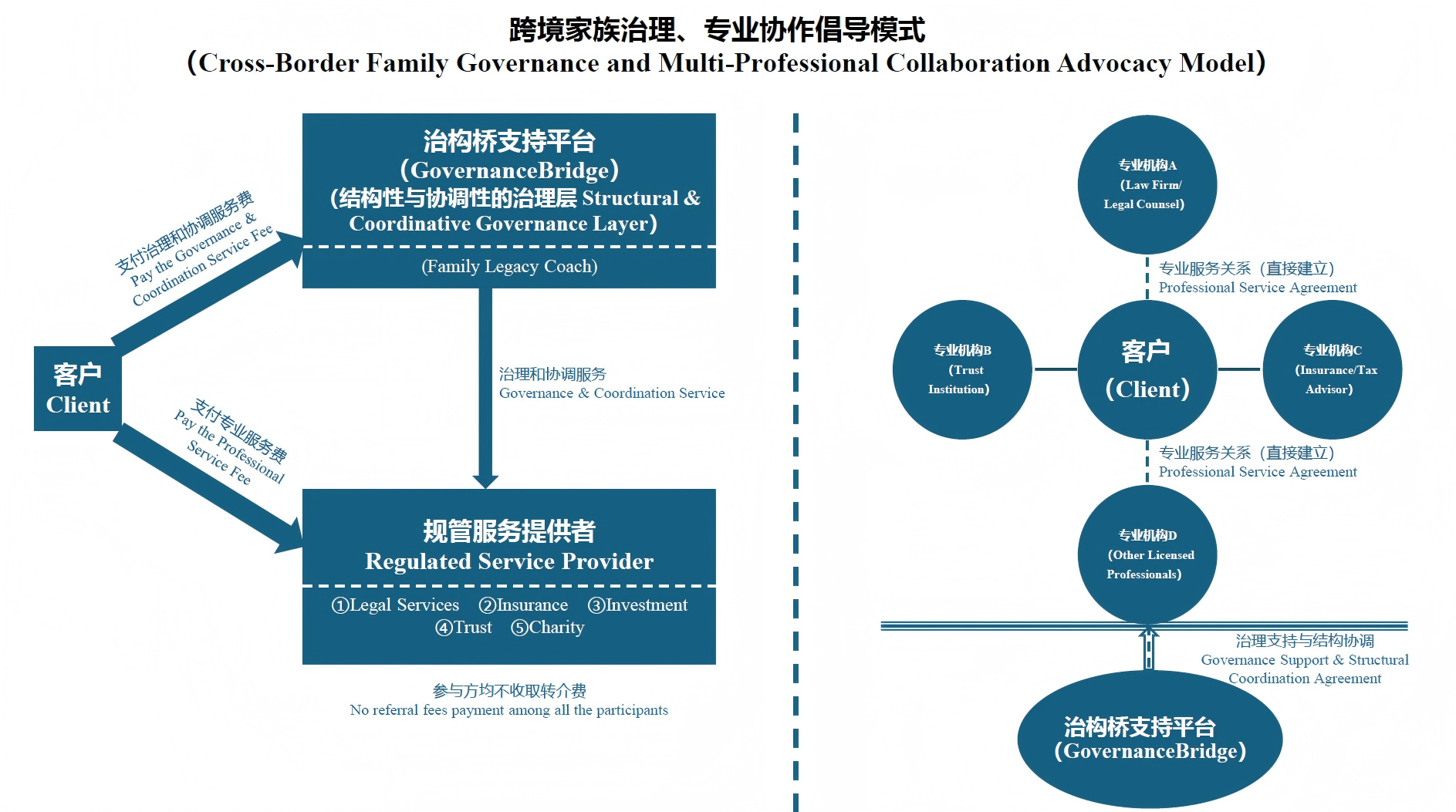
Within this structure:
clients establish independent service agreements directly with professional institutions;
professional institutions independently provide regulated services and assume responsibility;
GovernanceBridge provides governance support and structural coordination solely in a structural and coordinative capacity; and
the Platform does not participate in professional service execution, professional fee arrangements, professional determinations, or transaction execution.
(4) Platform Neutrality Through Structural Separation
By introducing a governance support layer, collaboration relationships are structurally reconstructed away from referral fee–based linkage and toward governance-based coordination. Under this model:
the Platform does not receive referral fees or commissions;
the Platform does not participate in professional fee pricing or allocation;
the Platform does not recommend, designate, or endorse professional institutions; and
the Platform does not become a party to professional service agreements.
This structural reconstruction preserves professional independence and ensures platform neutrality remains clear and defensible from a regulatory perspective.
(5) Governance Layer Functions
GovernanceBridge operates as a governance support layer within global collaboration structures. Its function is to:
support structural coordination and process continuity across jurisdictions;
provide governance continuity support; and
maintain structural stability and boundary clarity in cross-border collaboration.
The Platform does not replace professional institutions but supports the structural integrity of collaboration over time.